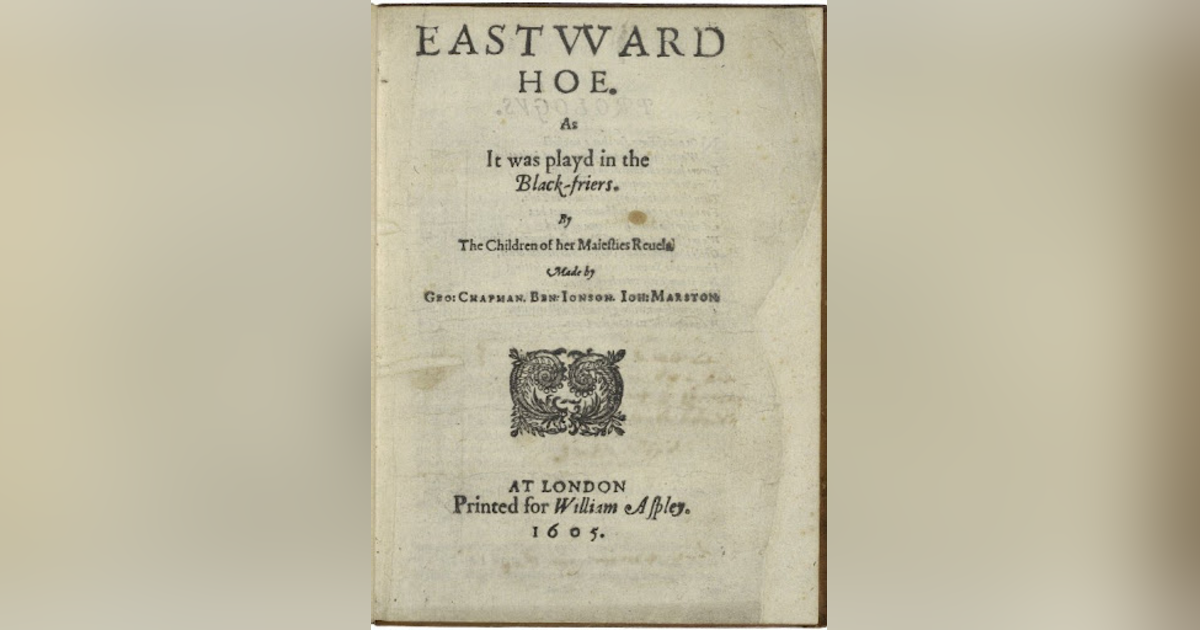
Eastward Ho: ‘He That Rises with Ease, Alas, Falls as Easily’


Episode 209:
After the failure of ‘Sejanus His Fall’ Jonson’s next play was a collaboration with John Marston and George Chapman, a new play for the Blackfriars’s theatre and it’s resident company of boy actors. Jonson maybe needed the collaboration to restore his confidence in his writing, although from what we know of his character perhaps more likely it was the hope of a decent payday that spurred him on. Returning to comedy must have been part of the attraction. Whatever the case the three playwrights managed to produce a comedy that was funny, thoughtful, moralistic and yet still controversial. The exact reasons for that controversy and the strength of reaction to the play from king James is now obscure to us, but at the time nearly cost the playwrights not only their liberty, but their ears as well.
The three authors of the play – who wrote what?
The first performance and printing of the play
A synopsis of the plot
The play as a response to ‘Westward Ho!’
The Prologue
The comparison of good and bad work ethics
The child acting companies and how their plays were received
Combining three types of play on ‘Eastward Ho’
The city comedy
The citizen comedy
The morality tale
Three journeys in the play
The voyage to Virginia
Gertrude’s journey
Golding’s rise in the city
Reference to the Roanoke settlement and the view of the New World
The fate of the adventurers after the shipwreck
The influence of the city of London and alchemy
The pairing of characters for dramatic effect
The theatrical nature of the play and Quicksilver’s redemption
The consequences of the play for the playwrights
The later performance history of the play
Support the podcast at:
www.thehistoryofeuropeantheatre.com
Hosted on Acast. See acast.com/privacy for more information.